Nitrate-Rich Foods and Nitric Oxide Before Training
How beetroot, rocket and spinach raise nitric oxide, why mouthwash matters, and how dietary nitrate compares with citrulline and arginine pre-workout.
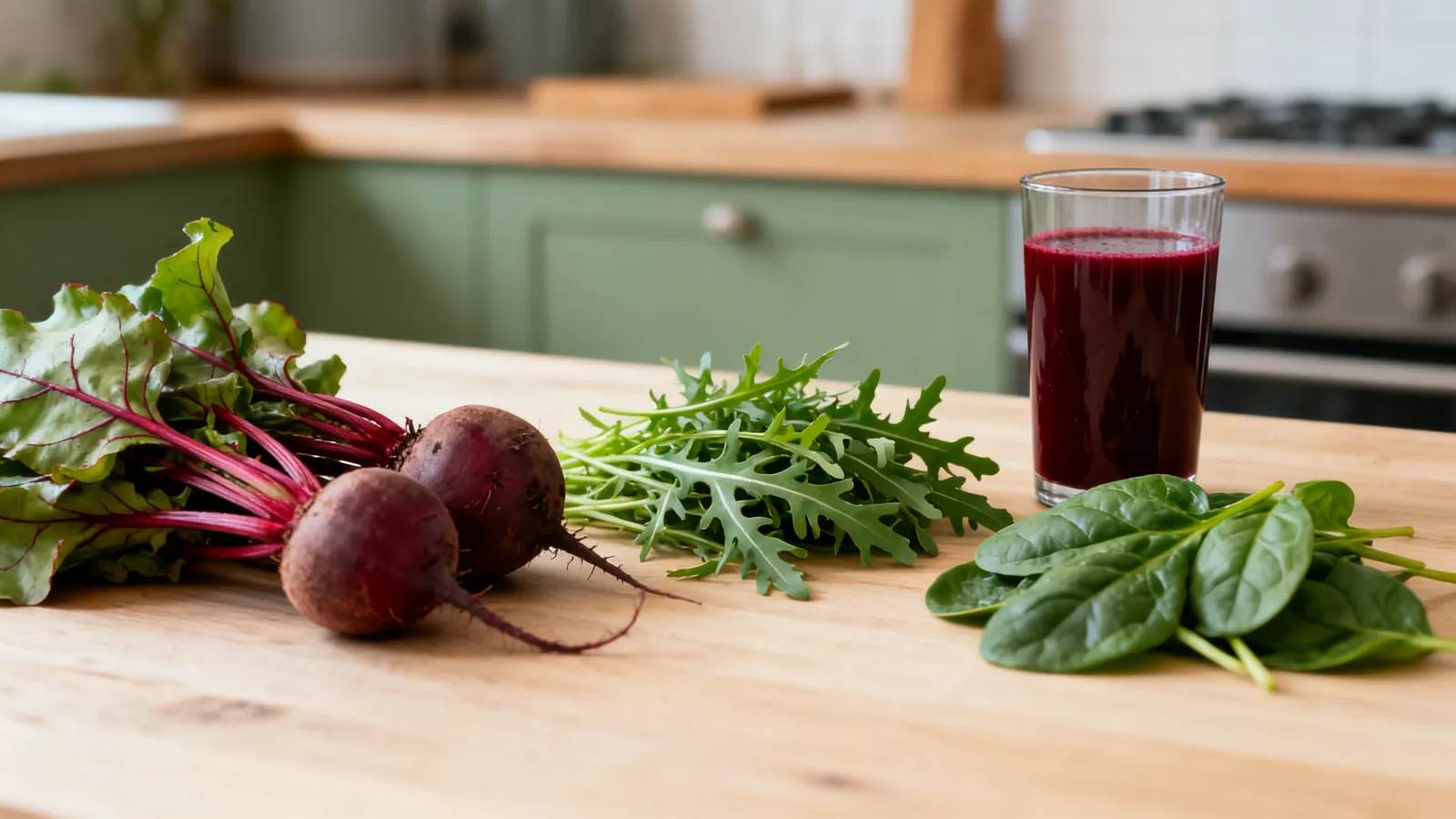
Nitric oxide is a short-lived gas the body makes continuously. It relaxes the smooth muscle in blood vessel walls, which widens them and increases blood flow, and it plays a role in how hard a working muscle can be supplied with oxygen. There is no food that contains nitric oxide itself — it is a gas with a half-life of seconds. What foods contain are the raw materials: nitrate (NO3-) and, to a lesser extent, the amino acids the body uses to make nitric oxide by other routes. The practical question is which foods supply enough nitrate to matter, how the body converts it, and how that compares with the ingredients in a pre-workout tub.
How nitrate from food becomes nitric oxide
Dietary nitrate is absorbed in the upper small intestine and reaches the blood within about an hour. Most of it is eventually excreted, but a portion is actively pulled back out of the blood by the salivary glands and concentrated in saliva. That is the step most people miss.
When nitrate-rich saliva is swallowed, bacteria that live on the surface of the tongue reduce nitrate to nitrite (NO2-). Nitrite is then swallowed, absorbed, and converted to nitric oxide in the blood and tissues, particularly where oxygen is low — which includes working muscle. This nitrate–nitrite–nitric oxide pathway works alongside the oxygen-dependent route that uses the amino acid L-arginine and the enzyme nitric oxide synthase.
The bacterial step is fragile. Antibacterial mouthwash used twice a day has been shown in small trials to reduce the rise in nitrite after a nitrate dose, and in one widely cited study it also blunted the blood-pressure-lowering effect of beetroot juice. Spitting rather than swallowing during the hour or two after a nitrate-rich meal removes the substrate before it can be recycled. Neither is a reason to skip oral hygiene; it is a reason not to use an antiseptic rinse immediately around training or a nitrate dose.
What the research shows, and how strong it is
The evidence for dietary nitrate is better than for most sports supplements, but it is not uniform.
- Time to exhaustion and exercise economy. Reviews of trials in recreationally active and trained adults generally find a small improvement in how long a fixed-intensity effort can be sustained, and a small reduction in the oxygen cost of submaximal exercise. Effects are more consistent in cycling and running than in short, all-out efforts.
- Blood pressure. Beetroot juice and other nitrate sources have been studied for resting blood pressure in healthy adults and in people with elevated blood pressure. Reviews report small average reductions, with wide variation between individuals and between studies. This is a research finding, not a treatment.
- Strength and sprint performance. Evidence here is weak and mixed. Nitrate does not appear to do much for a one-rep max or a 30-metre sprint.
- Trained versus untrained. The effect tends to be smaller in highly trained endurance athletes, whose baseline nitric oxide production and blood flow are already efficient.
The honest summary: nitrate is one of the few food-derived compounds with a plausible mechanism and repeated small-trial support for endurance-type work. The size of the effect is modest, individual response varies, and no single study settles it.
Which vegetables actually carry nitrate
Nitrate content depends on species, soil nitrogen, light, and how the crop was grown, so any table is a range rather than a fixed number. Leaf and root vegetables accumulate the most.
| Source | Typical nitrate level | Practical notes | Who it does not suit |
|---|---|---|---|
| Beetroot and beet juice | High | Concentrated shots are the most studied format; juice is bulky and sweet | People on warfarin (beet greens carry vitamin K); anyone advised to restrict potassium or oxalate |
| Rocket (arugula) | High | Small servings go a long way; peppery raw | People on blood thinners; those with a history of oxalate kidney stones |
| Spinach | High | Cooked or raw; also high in oxalate and vitamin K | Warfarin users; stone formers; anyone on a potassium-restricted diet |
| Celery | Moderate to high | Easy to eat in quantity; also a source of apigenin | People on potassium-restricted diets |
| Lettuce (especially romaine and butterhead) | Moderate | Lower per gram, but eaten in larger portions | Low risk for most |
| Cured and processed meats | Nitrite, not nitrate | A different compound with a different fate in the body | Not a nitric oxide strategy; intake is generally advised to be limited |
Cured meats are worth separating out. They are preserved with sodium nitrite, not nitrate, and the concern attached to them is the formation of nitrosamines during high-temperature cooking and in the stomach, not nitric oxide production. Treating bacon as a pre-workout nitrate source confuses two different chemistries.
How much nitrate, and when to take it
Studies have commonly used 300–600 mg of nitrate per dose, taken 2–3 hours before exercise. That window matters: plasma nitrite peaks roughly 1.5–3 hours after ingestion, which is why a shot taken in the changing room does little.
Translating that into food is imprecise because crop nitrate varies, but as a working guide:
- Concentrated beetroot juice shots are the format used in most trials, because the dose is standardised and the volume is small.
- Whole beetroot: a large serving, roughly 200–300 g, sits in the same range as a shot, but with more sugar, fibre and volume.
- Rocket or spinach: a generous 100 g raw serving can contribute a meaningful share of a 300–600 mg dose, though levels swing widely.
For most people, a single daily dose on training days is the pattern studied. Loading for several days before an event has also been used in trials and appears to produce a more stable effect than a single dose, at the cost of more juice and more sugar.
Where nitrate sits next to citrulline, arginine and caffeine
Nitrate is one of several pre-workout ingredients that touch nitric oxide or blood flow, and they are not interchangeable.
| Ingredient | How it works | Amounts commonly studied | Timing | Who should avoid it |
|---|---|---|---|---|
| Dietary nitrate (beetroot, rocket, spinach) | Nitrate–nitrite–nitric oxide pathway, depends on oral bacteria | 300–600 mg nitrate | 2–3 hours before | Warfarin users; potassium- or oxalate-restricted diets |
| L-citrulline / citrulline malate | Converted to arginine, raising substrate for nitric oxide synthase | 6–8 g citrulline; 6–8 g citrulline malate | 40–60 minutes before | People on blood-pressure medication or nitrates for angina; those with hypotension |
| L-arginine | Direct substrate, but heavily broken down before it reaches circulation | 3–6 g | 30–60 minutes before | Same cardiovascular cautions; can cause stomach upset |
| Beta-alanine | Buffers acid in muscle; unrelated to nitric oxide | 3–6 g daily, divided | Any time, taken daily for weeks | Not for those who cannot tolerate paresthesia |
| Caffeine | Central stimulant, not a vasodilator | 3–6 mg per kg body weight | 30–60 minutes before | Heart conditions, arrhythmias, uncontrolled blood pressure, pregnancy, anxiety disorders, poor sleep |
The tingle people describe from pre-workouts is usually beta-alanine paresthesia — a harmless prickling of the skin that fades with regular use. It is not a sign the product is working. Jitters, a racing pulse and a crash are caffeine effects, and they scale with dose. Caffeine at 3–6 mg per kg is the range used in performance research; higher doses add side effects without adding benefit. Anyone with a heart condition, uncontrolled blood pressure, an arrhythmia, or who is pregnant should treat stimulant pre-workouts as off the table and speak to a clinician first.
Side effects, interactions and who should avoid nitrate loading
Beetroot juice is generally well tolerated. The most common complaints are beeturia — red or pink urine and stool — which is harmless, and mild stomach discomfort from the volume and sugar in juice. Rocket and spinach in large raw amounts can cause bloating.
Interactions and cautions worth knowing:
- Blood-pressure medication and nitrate drugs. Dietary nitrate lowers blood pressure modestly. Combined with antihypertensives, or with nitrate medication for angina such as glyceryl trinitrate, the drop can be larger. Do not stop or change any prescribed medication to try a nitrate protocol; talk to the prescriber first.
- Warfarin and other vitamin K antagonists. Beet greens, spinach and rocket are high in vitamin K, which directly opposes warfarin. Consistent intake matters more than avoidance, but any change should be discussed with the prescriber.
- Kidney stones. Spinach and beetroot are high in oxalate. People with a history of calcium oxalate stones should be cautious with large, frequent servings.
- Potassium-restricted diets. These vegetables are also potassium-rich, which matters in advanced kidney disease.
- PDE-5 inhibitors. Drugs such as sildenafil already act on the nitric oxide pathway. Stacking a large nitrate dose is not a studied combination and is best discussed with a pharmacist.
- Pregnancy and breastfeeding. Nitrate supplementation has not been established as appropriate in pregnancy. Food amounts are a different question from concentrated shots; ask a clinician.
- Children and adolescents. Performance nitrate protocols are studied in adults.
Anyone taking prescription medication, pregnant or breastfeeding, or managing a medical condition should speak to a doctor or pharmacist before starting a nitrate or pre-workout regimen.
Common mistakes and what nitrate cannot do
- Expecting a pump. Nitrate improves exercise economy and endurance capacity. It is not a muscle-building agent and does not produce the acute fullness associated with citrulline.
- Taking it minutes before training. The peak is 2–3 hours out. A shot at the gym door is largely wasted.
- Using antiseptic mouthwash around the dose. It removes the bacteria the pathway depends on.
- Confusing cured meat with beetroot. Nitrite in processed meat is a different compound with different health considerations, and processed meat is not a nitric oxide strategy.
- Assuming more is better. The studied range is 300–600 mg of nitrate. Beyond that, the evidence does not show additional benefit, and blood pressure effects may become less welcome.
- Ignoring the label on a pre-workout. Nitrate content is rarely disclosed. If a tub does not state the nitrate dose, there is no way to know whether it matches the research.
- Treating any of this as a substitute for prescribed care. Nitrate-rich food is a dietary pattern, not a therapy for high blood pressure or heart disease.
Common questions
Which foods are highest in nitrates for nitric oxide?
Beetroot, rocket (arugula), spinach, celery and lettuce accumulate the most nitrate, with levels varying by soil and growing conditions. Beetroot juice shots are the format used in most exercise trials because the dose is standardised. No food contains nitric oxide itself; the body converts nitrate to nitrite and then to nitric oxide.
How long before a workout should beetroot juice be taken?
Studies have commonly used a dose 2–3 hours before exercise, when plasma nitrite peaks. Taking it minutes beforehand misses that window. Some trials also load for several days before an event, which appears to give a more stable effect.
Does mouthwash reduce the nitric oxide effect of beetroot?
Antibacterial mouthwash can reduce the oral bacteria that convert nitrate to nitrite, and small trials have found a blunted blood-pressure response to beetroot juice after regular use. Avoiding antiseptic rinse in the hour or two around a nitrate dose is a reasonable precaution. Normal brushing is not the issue.
Is nitrate from processed meat the same as nitrate from vegetables?
No. Cured meats are preserved with sodium nitrite rather than nitrate, and the health concerns attached to them relate to nitrosamine formation, not nitric oxide production. Processed meat is not a practical or advisable way to raise nitric oxide.
Who should not load up on nitrate-rich foods?
People taking warfarin should be consistent with vitamin K-rich greens such as spinach and beet greens and discuss changes with their prescriber. Those with a history of oxalate kidney stones, potassium-restricted diets, or who take blood-pressure medication or nitrate drugs for angina should check with a doctor or pharmacist first. Anyone pregnant or breastfeeding should do the same.
Read next

L-Citrulline vs L-Arginine: Which and How Much
L-citrulline and L-arginine compared: how each works, the amounts studied, citrulline malate versus pure powder, timing, side effects and who should avoid them.
Nitric Oxide Supplements: Citrulline, Arginine and Nitrate
How nitric oxide supplements work, why citrulline beats arginine, nitrate dosing, caffeine limits, and who should avoid these pre-workout ingredients.
Non-Stim Pre-Workout: Ingredients, Doses, Who It Suits
A non-stim pre-workout relies on citrulline, beta-alanine, nitrates and glycerol. What the research shows, doses studied, and who should skip caffeine.